Family Chore Chart: A Simple System That Works

A family chore chart works when every person can quickly answer three questions: What is my job? When does it need to happen? How will everyone know it is done? The best chart is not the prettiest or most detailed. It is the one your household can still follow on a busy Wednesday.
This guide shows you how to build a simple family chore system, divide work fairly across different ages, choose between fixed and rotating jobs, and handle reminders, rewards, and missed chores. You will also find three ready-to-copy chart examples for different family needs.
What should a family chore chart include?
A useful household chore chart needs five pieces of information:
The task: Name the job clearly enough that everyone understands it.
The owner: Assign one person who is responsible for follow-through.
The timing: Show the day, frequency, or routine cue.
The standard: Define what finished means for larger jobs.
The completion method: Decide whether the job is checked off, reviewed, or approved.
Rewards can be part of the system, but they are optional. A chart should first make household responsibilities visible. If every task depends on a prize, routine work can become a daily negotiation.
The American Academy of Pediatrics recommends making chores part of the family routine and notes that charts or checklists can clarify expectations and provide a sense of accomplishment.
How to make a family chore chart in 7 steps
1. List the work that keeps your home running
Begin with the work, not the people. Walk through a normal day and week and write down recurring jobs: dishes, meals, pet care, laundry, trash, bathrooms, floors, bedrooms, school preparation, outdoor work, and household restocking.
Do not turn every invisible action into a separate checkbox. "Clean up after dinner" may be easier to manage than six tiny tasks if one person or team owns the full process. Break a job down only when someone is still learning it.
2. Separate personal responsibilities from family contributions
Personal responsibilities include caring for your own belongings and routines: putting clothes in the hamper, packing a backpack, making a bed, or managing a bedroom. Family contributions benefit everyone: loading dishes, feeding a pet, taking out trash, or cleaning a shared bathroom.
A balanced chart includes both. Children learn self-management while also seeing that each person contributes to shared life.
3. Match chores to age and ability
Assign jobs based on demonstrated skill, safety, physical ability, attention, and schedule. Age is a starting point, not a guarantee. A younger child with practice may handle a task that is new to an older sibling.
Age | Possible responsibilities |
|---|---|
2-3 | Put toys in bins, carry safe items, place clothes in hamper |
4-5 | Set napkins, match socks, water plants, help feed pets |
6-8 | Make bed, sweep, sort laundry, empty small trash cans |
9-12 | Do laundry, vacuum, clean a bathroom, prepare simple food |
13+ | Cook meals, deep-clean rooms, handle yard work and errands |
For a fuller list, use our age-appropriate chores guide or browse the detailed lists for ages 4-5, ages 6-8, ages 9-12, and teenagers.
4. Decide which jobs stay fixed and which rotate
Fixed chores build mastery because the same person repeats the job. Rotating chores spread unpopular work and teach a wider range of skills. Most families benefit from combining both.
Keep personal responsibilities fixed. Each person owns their room, belongings, and routine.
Keep specialized jobs fixed while someone learns. Repetition helps a new skill become reliable.
Rotate comparable shared jobs. Dishes, trash, table cleanup, and common rooms can move weekly.
Do not rotate hazards casually. Confirm training and supervision before assigning tools, heat, chemicals, or heavy work.
5. Put chores at realistic times
A chart fails when every job is assigned to the family's busiest hour. Place short recurring work near routines that already happen: unload dishes before breakfast, reset backpacks after school, clear the table after dinner, or gather laundry before bedtime.
Move larger jobs to open parts of the week and account for sports, homework, work schedules, shared custody, and rest. Our weekly chore schedule explains how to spread jobs without sacrificing the weekend.
6. Define what done means
"Clean the bathroom" can mean very different things to a child and an adult. For a multi-step job, agree on the finish line before the work begins. A bathroom checklist might include the sink, mirror, toilet, towels, trash, and floor.
Standards should match the child's experience. A new learner needs a checklist and review. A capable teenager may only need a deadline. When the standard changes, teach the new version rather than treating the old version as disobedience.
7. Review the system once a week
A five-minute family reset is enough. Confirm the next rotation, account for schedule changes, recognize completed work, and repair any task that repeatedly falls through.
Change the system when the pattern shows a problem. Do not rewrite the rules in the middle of every disagreement. The American Academy of Child and Adolescent Psychiatry recommends clear expectations, regular routines, consistency, manageable tasks, and positive feedback.
Family chore chart example 1: simple daily chart
This model works for a household with younger children or anyone starting from scratch.
Person | Morning | After school or work | After dinner |
|---|---|---|---|
Parent | Start laundry | Check mail and supplies | Pack leftovers |
Older child | Feed pet | Reset backpack | Load dishwasher |
Younger child | Put pajamas away | Put shoes and toys away | Set napkins |
Keep the chart small until these jobs happen consistently. A short chart that gets used is more valuable than a complete inventory everyone ignores.
Family chore chart example 2: weekly rotation
This approach works well when children can handle several shared jobs of similar difficulty.
Week | Child A | Child B | Child C |
|---|---|---|---|
1 | Dishes | Trash and recycling | Pet care |
2 | Pet care | Dishes | Trash and recycling |
3 | Trash and recycling | Pet care | Dishes |
Rotate effort, not merely the number of tasks. One demanding job may be fair beside two short ones. Adjust for age and ability rather than forcing identical assignments.
Family chore chart example 3: zones plus personal jobs
A zone chart gives each person ownership of a shared area for the week.
Person | Personal baseline | Weekly zone | Zone standard |
|---|---|---|---|
Adult 1 | Personal laundry | Kitchen | Counters, sink, floor, supplies |
Adult 2 | Schedule and belongings | Entryway | Shoes, mail, floor, bags |
Older child | Room and laundry | Family room | Items away, surfaces, vacuum |
Younger child | Toys and hamper | Pet station | Food area tidy with adult help |
Zones reduce the question of who should notice a problem. They work best when the zone is small enough for the person assigned and the finish standard is visible.
Paper chore chart or chore chart app?
A paper chart is inexpensive, highly visible, and easy for young children to understand. It works well for a small number of stable tasks in one home. It becomes harder to manage when chores rotate, schedules change, rewards need totals, or family members need access from different places.
A chore chart app can automate recurring assignments, reminders, rotations, approvals, and reward tracking. It also avoids rewriting or reprinting the chart each week. Our full app versus paper chart comparison can help you choose.
If you want reminders and rotating assignments alongside the chart, compare the best chore apps for families before choosing where the household list will live.
Should a family chore chart include rewards?
Rewards are most useful when they support a specific behavior instead of paying for every normal contribution. Families commonly choose one of three models:
Unpaid family contribution: Regular chores are part of belonging to the household.
Chore-based allowance: Payment depends on completing an agreed set of jobs.
Hybrid system: Basic responsibilities are unpaid, while optional extra jobs earn money or rewards.
Stars, privileges, choosing an activity, and custom family rewards can work alongside money. Decide the rule before the work begins and keep it consistent. See our guides to building a chore reward system and paying children for chores.
What happens when chores are not done?
First determine why. The child may not understand the job, remember the timing, have the skill, or have enough time. Fix a system problem before treating it as a motivation problem.
If the expectation was clear and manageable, use a calm, related response. The chore still needs to be completed, a privilege may wait until responsibilities are finished, or the person may need to repair the effect on someone else. Avoid surprise punishments and long lectures.
Repeatedly unfinished work is useful information. Reduce the number of assignments, change the timing, add a checklist, reteach the task, or move the reminder out of the parent's voice and into the system.
Manage the family chore chart with Xtra Hands
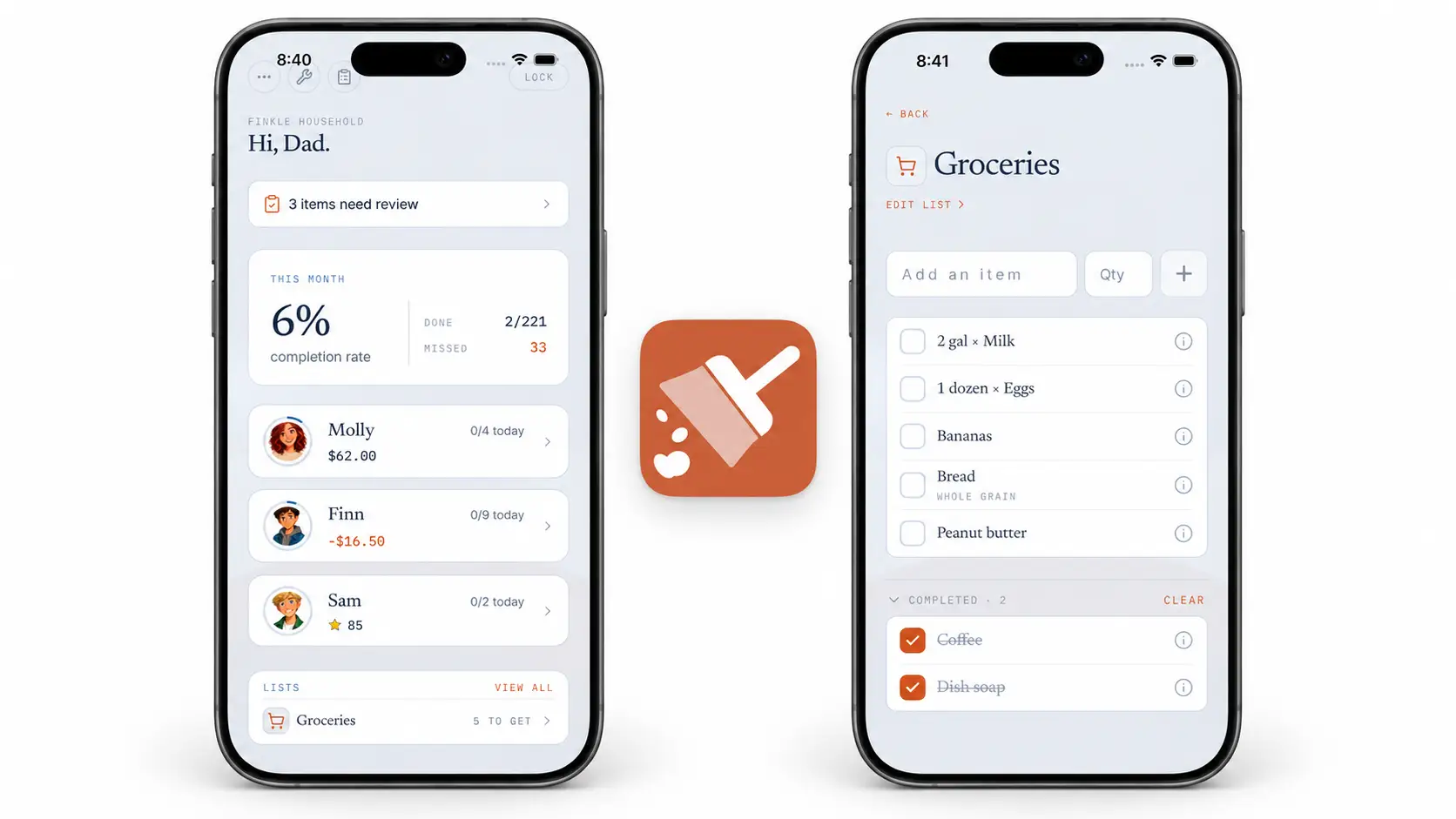
Xtra Hands lets families create recurring and one-time chores, rotate shared jobs, send reminders, request approval or optional photo proof, and track money, stars, or custom rewards. Unpaid household responsibilities can live beside rewarded work in the same family system.
Everyone does not need the same kind of phone. Xtra Hands syncs across iOS and Android, making it practical for mixed-device households. The first member gets every feature free with no trial deadline, so you can build the chart and test the routine before adding the family.
Frequently asked questions
How do you make a fair family chore chart?
Compare time, effort, difficulty, ability, and schedule rather than giving everyone the same number of jobs. Personal responsibilities can stay fixed while comparable shared chores rotate.
How often should chores rotate?
Weekly rotations are easy to remember and give each person enough repetition to learn the job. Keep a chore fixed longer when someone is still building the skill or when continuity matters.
Should parents be included on the chore chart?
Usually, yes. Showing at least some adult household work makes the chart feel like a family system rather than a list imposed on children. It also makes invisible work easier to discuss and divide.
How many chores should each child have?
There is no universal number. Begin with a personal baseline, one short daily contribution, and one or two weekly jobs for a school-age child, then adjust for age, time, and total effort.
What makes a chore chart fail?
Common causes include too many tasks, vague wording, unrealistic timing, constant rule changes, missing instruction, and a chart that depends on parents reminding everyone to look at it. Simplify until the system is easier to use than to ignore.
Build the smallest system your family will use
Start with the jobs that matter most this week. Assign one owner, choose a realistic time, and define what done means. Review the chart after seven days and change only what the week taught you.
A family chore chart should make home life clearer, not turn it into a management project. When you are ready to automate the repeating parts, build your household system with Xtra Hands.