How to Manage Chores Across Two Homes

Managing chores across two homes works best when each household has clear expectations, the adults communicate directly, and children know what to expect when they arrive. The homes do not need identical chore charts, rewards, or rules. They do need routines that are understandable and appropriate within each home.
A two-home chore system should make family life more predictable, not pull a child into adult communication or turn chores into a comparison between parents. This guide covers shared principles, transition days, belongings, allowance, blended families, and ways to coordinate without expecting both households to run the same way.
Consistency does not mean identical homes
Children can learn that different places have different rules. School, grandparents' homes, sports, and two family households may each operate differently. What matters is that expectations are clear and reasonably consistent within each setting.
Parents may agree on broad principles while using different systems:
Everyone contributes in an age-appropriate way.
Personal belongings are cared for.
Homework, hygiene, food, and sleep remain priorities.
Children are taught a task before they are expected to own it.
Mistakes are handled without shame or messages sent through the child.
One home may rotate kitchen jobs while the other uses fixed assignments. One may use allowance while the other keeps routine chores unpaid. Those differences are manageable when the child knows what applies in each place.
The American Academy of Pediatrics recommends maintaining regular meals, chores, and bedtimes where possible and keeping children out of adult disagreements and messenger roles.
Start with a chore baseline for each home
Each household should define the small responsibilities that apply whenever the child is there. A baseline might include:
Put shoes, coat, and bag in their assigned places.
Carry dishes to the sink or dishwasher.
Place dirty clothes in a hamper.
Reset personal belongings before leaving.
Complete one short shared household job.
Keep the baseline short enough to survive school nights, transitions, and changing schedules. Larger weekly chores can be added when the child spends enough time in that home to learn and complete them without feeling that every visit is a work shift.
Match chores to time spent in each household
Equal expectations do not always mean equal task counts. A child who is in one home for two school nights and another for five days has different opportunities in each place.
Time in the home | Reasonable chore pattern |
|---|---|
One overnight | Arrival reset, meal contribution, personal cleanup, departure reset |
Weekend | Daily baseline plus one useful shared or weekly job |
Several school nights | Daily routines, homework ownership, recurring household contribution |
Week-on, week-off | Full daily and weekly schedule appropriate to each home |
Focus on contribution relative to the child's presence. Avoid saving every unpopular job for the child who arrives on the weekend.
Create an arrival routine
Transition days carry extra demands. The child may be changing environments, reconnecting with family members, managing belongings, and shifting rules at once. Start with a routine that makes arrival predictable.
Greet and reconnect before beginning a list of demands.
Put the travel bag, shoes, coat, and school items in their homes.
Move medications or essential items to the responsible adult.
Place dirty clothing in a hamper and needed items in the correct room.
Review only the schedule information the child needs for that stay.
Allow time to settle before homework or household work begins.
A child who usually manages a routine well may need extra support during a family transition. Temporary help does not erase independence; it makes room for the emotional and practical load of changing homes.
Create a departure routine
A departure checklist helps protect school items, favorite belongings, and the next household from a preventable scramble.
Pack schoolwork, school equipment, and activity gear.
Collect necessary clothing, shoes, and outerwear.
Include comfort items and current books when they travel.
Return the bedroom or sleeping area to the household standard.
Finish time-sensitive chores such as pet care.
Have an adult complete the final check for essential items.
Do not make the child responsible for delivering adult messages, financial information, or conflict. Adults should communicate directly about schedules, supplies, and concerns.
Duplicate the essentials when possible
Constantly transporting every basic item increases the chance of forgetting something and can make one home feel temporary. When resources allow, keep everyday essentials in both places:
Toothbrush and basic toiletries.
Pajamas, underwear, socks, and a few everyday outfits.
School and art supplies.
Phone or device chargers for older children.
Basic medication only when safely managed by the responsible adults.
Favorite books, comfort items, or close equivalents for younger children.
The AAP specifically suggests keeping duplicates of favorite bedtime books, toys, or music when children divide time between homes. Fewer essential items traveling back and forth means fewer opportunities for the child to feel responsible for an adult logistics problem.
Choose fixed chores before rotating chores
Fixed chores are easier to remember in a home the child enters only part of the week. Start with a job connected to a visible cue:
Feed the pet after breakfast.
Set napkins before dinner.
Empty the lunchbox after school.
Take bedroom trash out on the final evening.
Put towels in the laundry before departure.
Use rotations when siblings or step-siblings share enough time in the home for the pattern to feel fair. A rotation that changes while one child is away can be confusing unless the system clearly shows whose turn is active.
Handling different rules in each home
When expectations differ, explain the local rule without criticizing the other home. Keep the language simple: "At this house, everyone clears their place after dinner." A child does not need to agree that one system is better to follow the rule where they are.
If a chore becomes a repeated source of conflict, check:
Whether the child knows the rule applies in this home.
Whether the task was taught using this home's supplies and setup.
Whether the timing conflicts with transition fatigue or schoolwork.
Whether a sibling comparison is creating resentment.
Whether adult conflict is being expressed through the chore.
According to the Child Mind Institute, children can learn consistency within a particular household even when rules elsewhere differ. Clear local expectations are more useful than trying to enforce another adult's home from a distance.
Chores in blended families
Blended households can include children of different ages, schedules, experience levels, and time in the home. Do not assume the same number of chores is automatically fair.
Begin with personal responsibilities that apply to everyone.
Compare effort and time instead of counting tasks.
Teach household-specific jobs before adding them to a rotation.
Avoid assigning one child cleanup created entirely while they were away.
Give new relationships time before making a step-parent the primary chore enforcer.
Review assignments privately rather than debating fairness in the moment.
A family chore chart can make the current household's work visible without pretending every member has the same age, schedule, or role.
Allowance and rewards across two homes
Parents do not have to use the same allowance model. One home may pay a regular allowance, another may offer optional paid jobs, and both may keep basic contributions unpaid.
Clarify these questions inside each household:
Which chores are expected without payment?
Which extra jobs can earn money or stars?
Who approves completed work?
When is allowance settled?
Does a missed chore carry forward or expire?
Can rewards earned in one home be redeemed only there?
Separate household ledgers are often simpler when money and rules differ. A shared system can still help co-parents coordinate one household when they genuinely use the same agreement. See whether kids should get paid for chores for the main models.
How much should co-parents coordinate?
Coordinate the information that protects the child's well-being and schedule: school needs, medication, sleep concerns, transportation, activities, important belongings, and major changes. Chore details need shared coordination when both adults manage one household system or when unfinished work affects the other home.
Do not require the child to report on the other home's cleanliness, rules, or chore completion. The child should not be placed in the role of inspector, messenger, or evidence source.
When direct communication is difficult or unsafe, use the communication method recommended for your circumstances by qualified professionals. This article offers household organization ideas, not legal or mental health advice.
Using Xtra Hands across households
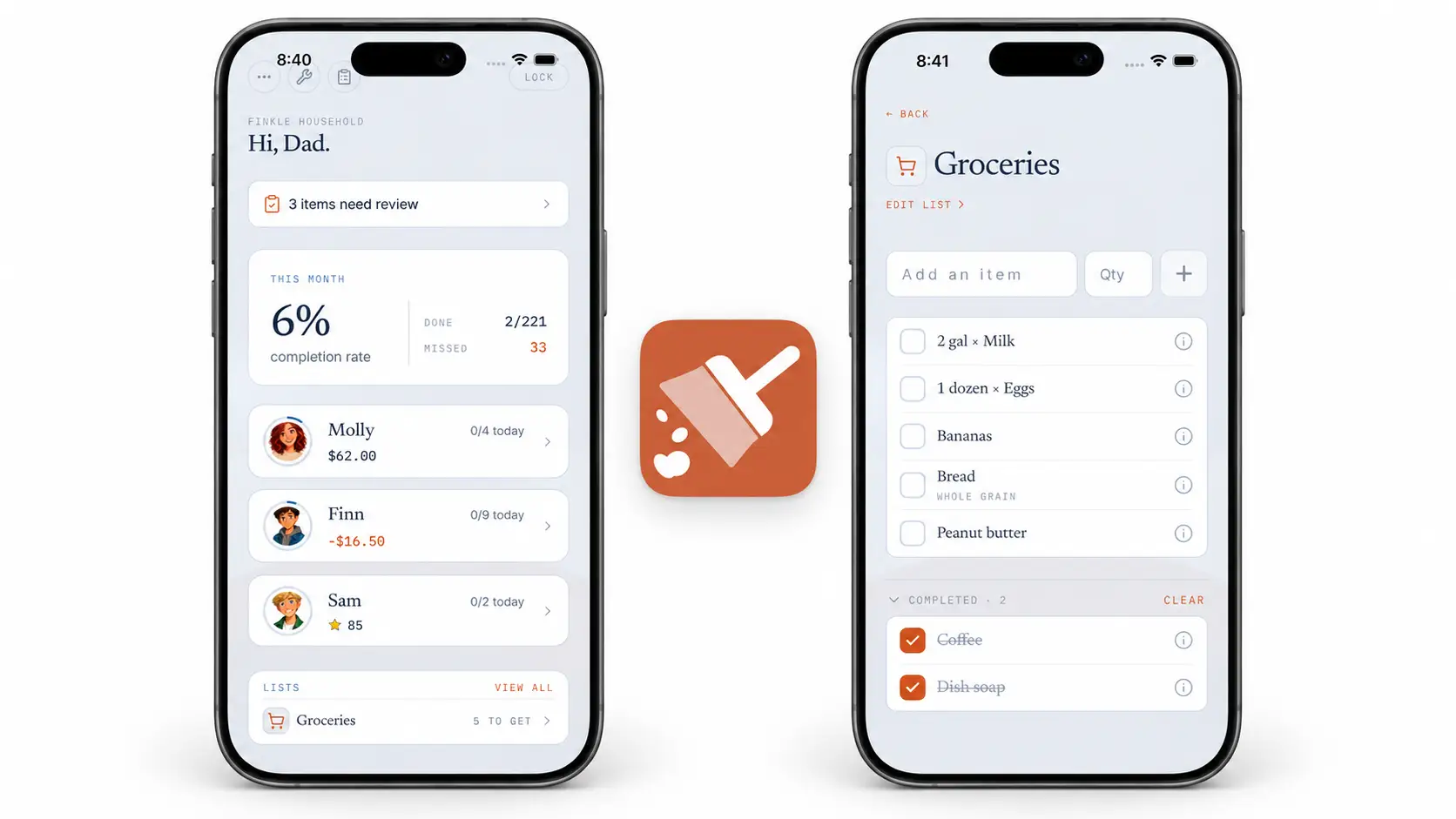
Xtra Hands supports co-parents and people who belong to multiple households. Parents can share one household when they truly manage the same chores, ledger, and approvals. Co-parents receive parent access without counting as paid chore members.
When homes need separate rules, schedules, balances, and member records, they can remain separate households. A parent can belong to more than one household without forcing the chores or ledger from one into the other.
Xtra Hands works on iOS and Android, so adults do not need matching phones. Personal devices, a shared household tablet, and parent-managed checkoff for children without phones can all participate. The first member gets every feature free with no trial deadline.
For setup details, read how to share family chores between iPhone and Android.
Sample two-home chore plan
Routine | Home A | Home B |
|---|---|---|
Arrival | Bag on bench, lunchbox to kitchen | Bag in bedroom, papers in tray |
Personal baseline | Hamper, room reset, school prep | Hamper, sleeping area reset, school prep |
Family contribution | Unload dishwasher after school | Set table before dinner |
Weekly job | Personal laundry during longer stay | Help clean shared bathroom on weekend |
Departure | Pack school and activity items | Pack school items and return towels |
The jobs differ, but the shared principles remain: care for belongings, contribute to the home, prepare for school, and leave the space ready.
Frequently asked questions
Should chores be the same at both parents' houses?
No. Broad expectations can be similar while specific jobs reflect each home's people, pets, layout, schedules, and values. Clear and consistent rules within each home matter more than identical lists.
Should kids do chores during short visits?
Children can still participate through arrival, mealtime, personal cleanup, and departure routines. Keep expectations proportional so a short stay does not become dominated by household work.
How do you handle forgotten belongings between homes?
Use arrival and departure checklists, keep duplicate essentials when possible, and have an adult perform the final check for critical items. Avoid blaming the child for complex household logistics.
Can co-parents share a chore app?
Yes. Co-parents can share one household when they jointly manage the same assignments and rules. Separate households may be clearer when each home has different chores, rewards, or balances.
What if the other parent does not use the same chore system?
Keep your own home's expectations clear and predictable. Do not ask the child to enforce, criticize, or report on the other home. Coordinate directly on essential matters when appropriate.
Give each home a dependable rhythm
Start with a small baseline for arrival, personal belongings, one family contribution, and departure. Teach those steps in each home and leave room for extra support on difficult transition days.
The goal is not to make two homes look identical. It is to help a child feel capable and know what comes next wherever they are. Use Xtra Hands to organize the household structure that fits your family.