How to Create a Weekly Chore Schedule for Kids

A weekly chore schedule for kids should answer three questions without a parent repeating them all day: What is my job? When should I do it? How will I know I am finished?
The most effective schedules are not packed with every task a child could possibly do. They are short, predictable, and built around the family's real week. This guide will help you separate daily habits from weekly chores, divide work fairly, and create a schedule your family can actually maintain.
Quick answer: build the schedule in five steps
List the household work that truly needs to happen.
Separate daily, weekly, and occasional chores.
Match each task to a child's current skills and available time.
Give every chore a specific deadline and definition of done.
Review the schedule once a week and adjust only what is not working.
Start with fewer assignments than you think you need. A simple schedule followed consistently will do more for your household than a perfect-looking chart everyone ignores by Wednesday.
Daily chores vs. weekly chores
Daily chores keep normal routines moving. Weekly chores maintain spaces or handle work that does not need attention every day. Mixing the two without clear labels can make a child's list feel endless.
Daily chores | Weekly chores |
|---|---|
Make or straighten the bed | Change bedsheets |
Put dirty clothes in the hamper | Wash and put away laundry |
Clear dishes after meals | Clean the kitchen after dinner |
Feed and water pets | Wash pet bowls or bedding |
Complete a ten-minute room reset | Vacuum or mop a room |
Pack a backpack for tomorrow | Clean out the backpack |
Wipe the table | Clean a bathroom |
Occasional chores form a third category. Washing the car, organizing a closet, raking leaves, or helping with a home project may happen monthly or seasonally. Keep these separate from the child's dependable weekly baseline.
Step 1: list the work before assigning it
Begin with the household, not the children. Write down the jobs that keep your home functioning during a normal week. Include work adults already do automatically, such as unloading the dishwasher, taking out recycling, wiping the bathroom sink, feeding pets, folding towels, and restocking supplies.
Then sort the list into four groups:
Personal care: making a bed, managing clothes, packing school items.
Shared daily work: setting the table, clearing dishes, feeding a pet.
Shared weekly work: vacuuming, cleaning a bathroom, doing laundry.
Optional extra jobs: projects that may earn money, points, or another reward.
This prevents a common mistake: building a schedule around random tasks for children while the rest of the household workload remains invisible.
Step 2: choose age-appropriate assignments
A fair schedule does not give every child identical work. It gives each person a meaningful contribution they can learn to complete safely.
Ages 3-5: put away toys, place clothes in a hamper, set napkins, match socks, water a plant.
Ages 6-8: clear dishes, sort laundry, sweep, wipe a table, empty small wastebaskets.
Ages 9-12: unload the dishwasher, vacuum, fold laundry, take out trash, prepare simple food.
Teenagers: cook meals, clean bathrooms, manage laundry, do yard work, shop from a list.
Use our full guide to age-appropriate chores for kids to find more options from toddlerhood through age eighteen. Remember that age is only a starting point. Experience, attention, motor skills, safety, and your home's setup all affect readiness.
Step 3: anchor chores to moments, not vague deadlines
"Do it sometime today" requires a child to remember the task, estimate time, choose a starting point, and resist every more interesting option. A routine cue removes several of those decisions.
Useful anchors include:
After getting dressed, straighten the bed.
After breakfast, put the dish in the dishwasher.
After arriving home, unpack the lunchbox.
Before screen time, complete the afternoon chore.
After dinner, handle the assigned kitchen job.
Before the bedtime routine, do a ten-minute reset.
The American Academy of Pediatrics notes that children benefit from regular, predictable, and consistent routines. A chore attached to an existing event is easier to remember than one floating somewhere in the day.
Step 4: define what "done" means
Many arguments that look like laziness are actually disagreements about the finish line. "Clean your room" may mean a clear walkway to a child and a fully organized space to a parent.
Use task names that describe an observable result:
Replace "clean room" with "put clothes in hamper, books on shelf, and toys in bins."
Replace "help with dinner" with "set plates, forks, napkins, and water cups."
Replace "do laundry" with "wash, dry, fold, and put away one load."
Replace "clean bathroom" with a short checklist for the sink, mirror, toilet, towels, and floor.
Teach a new chore before adding it to the independent schedule. Demonstrate it, do it together, let the child try, and review the result. A schedule can remind a child of a learned skill; it cannot teach a skill they have never practiced.
Step 5: decide whether chores stay fixed or rotate
Both systems can work. The right one depends on whether your current priority is mastery or variety.
Fixed assignments
Each person owns the same chore for several weeks or months. Fixed jobs reduce confusion and help children become genuinely competent. They work especially well for younger children and busy school weeks.
Rotating assignments
Shared jobs move between family members on a regular schedule. Rotation spreads out unpopular work and teaches a wider range of skills. It works best after everyone has learned each chore and the handoff date is obvious.
A useful compromise is to keep personal responsibilities fixed and rotate one or two shared household jobs every week. Avoid changing every assignment every day. Too much rotation creates more management than fairness.
Sample weekly chore schedule for ages 4-6
When | Assignment |
|---|---|
Every morning | Put pajamas away and pull up the bedcover |
After school or play | Put toys and shoes in their places |
After dinner | Carry napkin and unbreakable dish to the counter |
Tuesday | Water indoor plants with an adult |
Saturday | Match clean socks and dust a low shelf |
Keep the schedule visual and brief. At this age, the child may need a picture for each task and an adult nearby. Participation matters more than speed or precision.
Sample weekly chore schedule for ages 7-10
When | Assignment |
|---|---|
Every morning | Make bed and put breakfast dish in dishwasher |
After school | Unpack lunchbox and hang up backpack |
After dinner | Wipe the table |
Monday and Thursday | Feed the pet and refill water |
Wednesday | Empty bedroom and bathroom wastebaskets |
Saturday | Fold and put away personal laundry |
A child this age can usually follow a short written checklist, but introduce only one unfamiliar job at a time.
Sample weekly chore schedule for ages 11-14
When | Assignment |
|---|---|
Every morning | Make bed and manage breakfast cleanup |
Monday | Take out trash and recycling |
Tuesday | Run and put away one load of laundry |
Wednesday | Help prepare dinner |
Thursday | Vacuum one shared room |
Friday | Clean bathroom sink, mirror, and toilet |
Sunday | Change sheets and prepare school items |
Adjust the load around school and activities. A demanding Wednesday may need only the daily baseline, while a larger job fits Saturday morning. Fairness includes both the difficulty of a task and the time available to complete it.
How to schedule chores for multiple children
Begin with a shared master list so everyone can see that the schedule covers real household needs. Then use these rules:
Give each child personal responsibilities. Bedrooms, belongings, and laundry can grow with age.
Assign one shared daily role. Examples include table setter, dishwasher helper, or pet helper.
Assign one larger weekly role. Examples include floors, bathroom, laundry, or yard work.
Rotate only comparable jobs. Do not treat a five-minute wastebasket task as equal to cleaning a full bathroom.
Account for age and schedule. Equal effort is more useful than identical tasks.
Allow planned trades. Siblings can swap when both agree and the responsibility remains clear.
If a child claims the schedule is unfair, ask what specifically feels uneven: time, difficulty, frequency, or preference. The answer may reveal a real imbalance or simply an unpopular job that still needs an owner.
Should weekly chores earn money or rewards?
A schedule can include expected chores, paid jobs, or both. Many families use a hybrid approach:
Personal care and basic family contributions are expected.
Optional work beyond the baseline can earn money, stars, privileges, or custom rewards.
The reward and completion standard are agreed on before the work begins.
Whatever you choose, label it clearly. A child should not have to guess which jobs are part of belonging to the household and which are earning opportunities. See our guide on whether kids should get paid for chores for three workable models.
Paper schedule or chore app?
A paper schedule is excellent when the list is short, stable, and visible to everyone in one place. An app is useful when chores recur on different days, rotate between children, require reminders or approval, or need to be available beyond the refrigerator.
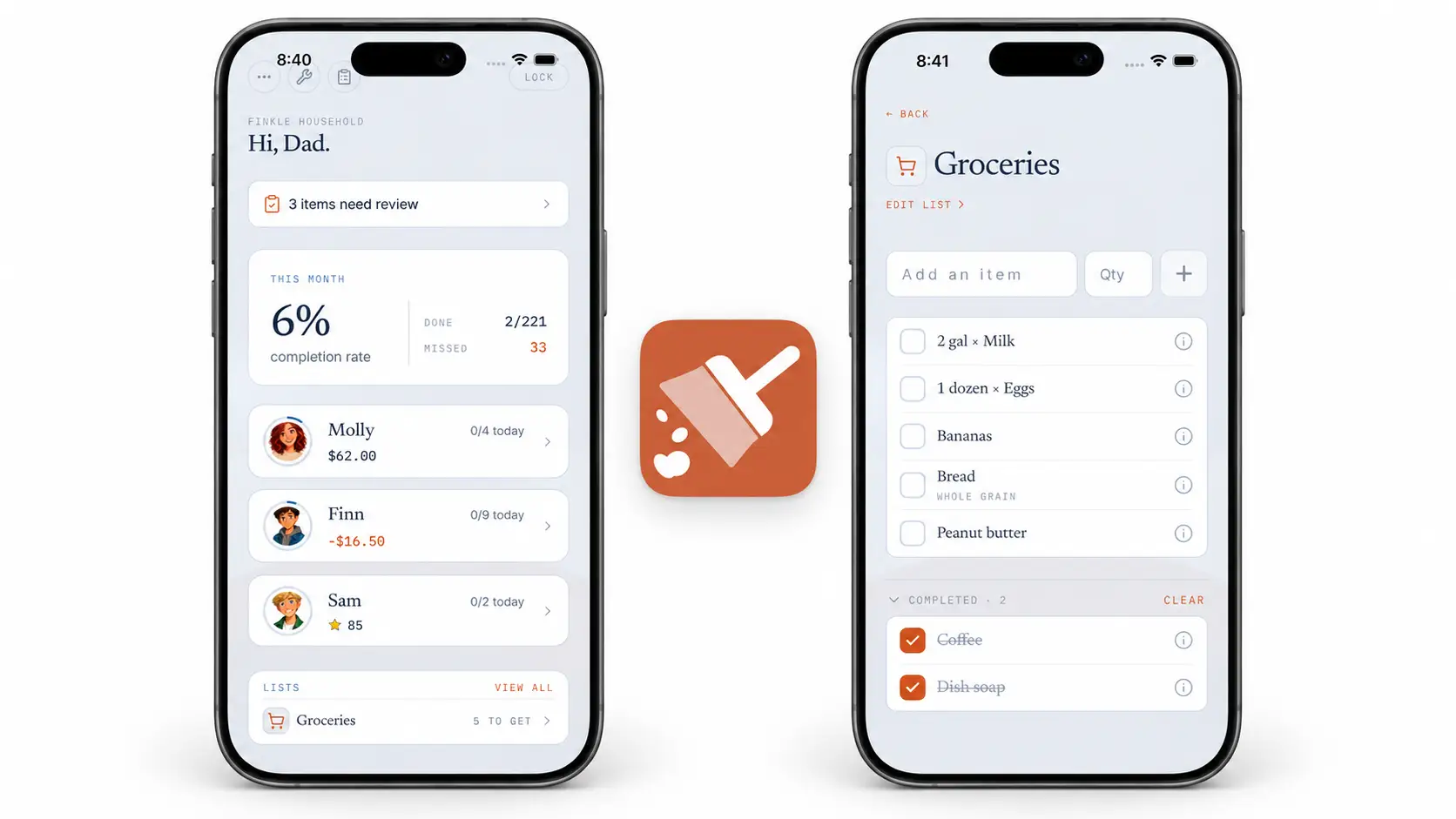
Xtra Hands can handle recurring and one-time chores, rotations, reminders, parent approval, optional photo proof, and money or star balances. Household members can share the same system across iOS and Android, which matters when a family uses a mix of devices.
One member gets every feature free with no trial deadline. Build the schedule first, then invite more household members when the routine is ready. For a fuller breakdown, read Chore Chart App vs. Paper Chart.
When you are ready to choose an app, our family chore app comparison covers the differences between chore trackers, allowance tools, shared calendars, and cleaning schedules.
Why weekly chore schedules fail
The list is too long. Remove low-priority work and establish a small baseline.
The chores are vague. Make the finish line visible and specific.
The timing is unclear. Tie each job to a day, deadline, or routine cue.
The child was never taught. Practice before expecting independent completion.
Parents change the system constantly. Keep it stable long enough to become familiar.
Nothing happens when work is skipped. Use calm, predictable follow-through instead of repeated warnings.
The schedule ignores real life. Plan around school nights, sports, custody schedules, and family commitments.
The American Academy of Child and Adolescent Psychiatry recommends clear expectations, regular routines, consistency, modeling, and positive feedback. Those basics matter more than how attractive the chart or app looks.
Hold a ten-minute weekly reset
Choose one dependable time, such as Sunday evening, to review the coming week. Keep the meeting short.
Notice what worked last week.
Check school, work, sports, and appointments.
Move chores away from unusually busy days.
Rotate shared assignments if it is rotation week.
Add one-time jobs.
Confirm rewards or allowance rules.
Do not rebuild a functioning schedule just to make it feel fresh. Change assignments when they are unsafe, unfair, outgrown, or consistently colliding with family life.
Frequently asked questions
How many chores should a child do each day?
There is no universal number. Start with one or two brief daily responsibilities for younger children. Older children can manage personal routines plus meaningful shared work. Judge the load by time, difficulty, and consistency rather than the number of lines on a chart.
Should kids do chores before or after homework?
Use the order that fits the child's energy and schedule. A short chore immediately after arriving home can create a clean transition, while a child who needs food and decompression may do better after a break. Keep the order predictable once you find what works.
How often should siblings rotate chores?
Weekly or monthly rotations are easier to remember than daily changes. Keep jobs fixed long enough for children to learn them, then rotate comparable shared responsibilities.
What should happen when a chore is not completed?
Start by checking whether the assignment was clear, taught, visible, and realistically timed. If the child chose not to do a known responsibility, use a calm consequence connected to the routine, such as completing the job before a privilege begins.
Do chores need to happen on weekends?
Not necessarily, but weekends often provide room for longer jobs. Many families keep a small daily baseline and schedule one larger household task on Saturday or Sunday. Preserve time for rest, play, and family plans.
Final take
A weekly chore schedule works when it makes responsibility easier to understand, not when it captures every possible task. Choose a small set of age-appropriate jobs, attach them to clear times, teach the expected standard, and review the plan once a week.
Start free with Xtra Hands and build a weekly schedule that stays in sync across your household.